

Disclosure This page carries advertising. We do not accept payment for coverage, and adverts are selected by the ad network rather than by us.
On this page12 sections
- Defining Quantum Computing
- Quantum Bits (Qubits) and Superposition
- Entanglement: The Magic of Quantum Mechanics
- Quantum Gates and Quantum Circuits
- Quantum Algorithms: Shor’s Algorithm and Grover’s Algorithm
- Quantum Computing Hardware: Quantum Computers and Quantum Processors
- Quantum Computing vs. Classical Computing
- The Advantages of Quantum Computing
- The Disadvantages and Challenges of Quantum Computing
- Advancements in Quantum Computing
- The Future of Quantum Computing
- Conclusion
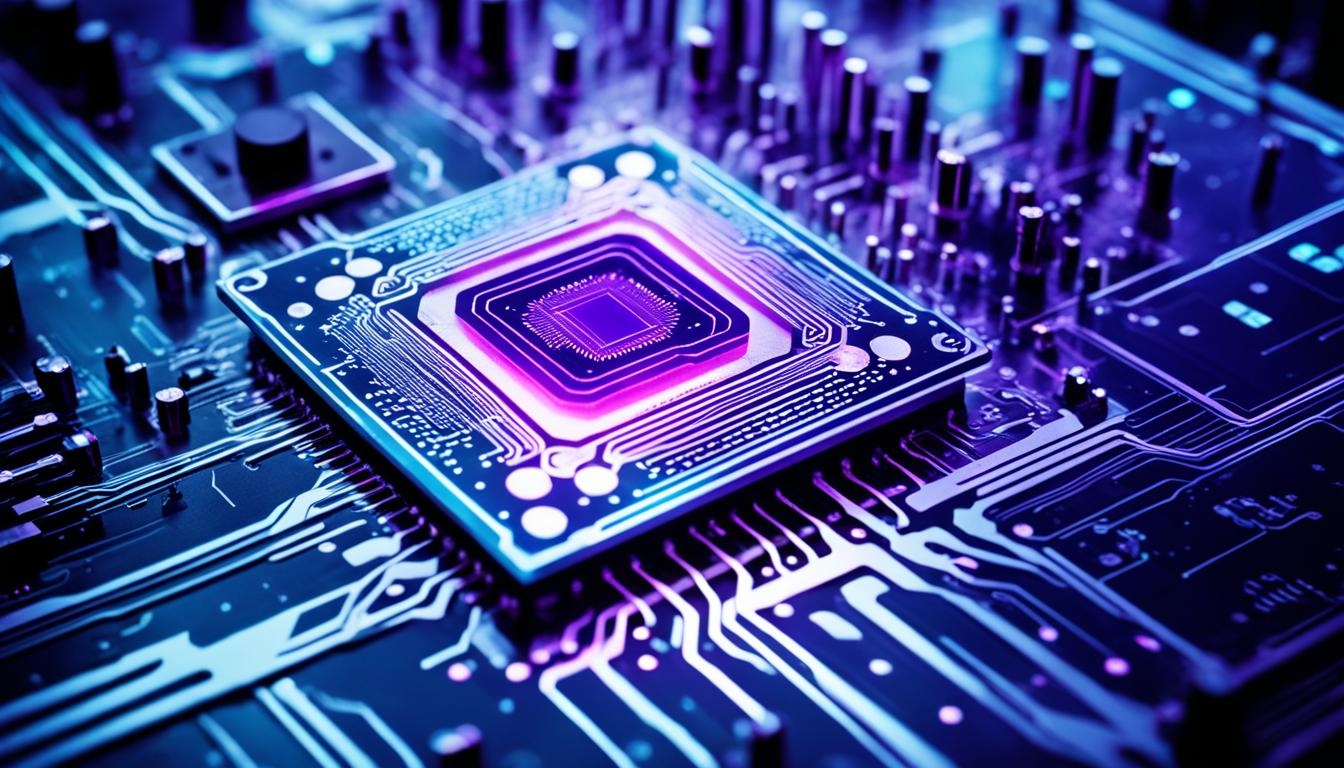
Did you know that quantum computer chips have the potential to outperform classical processors by a factor of a billion? That’s right, these advanced chips represent a paradigm shift in computing technology, harnessing the principles of quantum mechanics to process information in a fundamentally different way.
From quantum information processing to qubit chip design, quantum computing hardware is at the forefront of scientific breakthroughs and technological advancements. In this article, we will delve into the intricacies of quantum computer chips, exploring their architecture, performance, and the vast array of applications they enable.
Defining Quantum Computing
Quantum computing harnesses the principles of quantum mechanics to perform complex computations. Unlike classical computers that use bits to store and process information in binary form, quantum computers use qubits, which can represent both 0 and 1 simultaneously thanks to superposition. This unique property allows quantum computers to perform parallel computations and solve certain problems exponentially faster than classical computers.
Quantum mechanics is a branch of physics that explores the behavior of matter and energy at the smallest scales. It describes the behavior of particles such as electrons and photons and provides the foundation for quantum computing.
”
Quantum computing is a revolutionary concept that takes advantage of the fundamental principles of quantum mechanics to revolutionize computation. It offers a new way of computing that has the potential to tackle complex problems that classical computers struggle with.”
In classical computers, information is stored and processed in bits, which can be either 0 or 1. However, qubits, the building blocks of quantum computers, can exist in multiple states simultaneously thanks to the phenomenon of superposition. This means that a qubit can be both 0 and 1 at the same time, allowing for parallel computations and vastly greater computational power.
Superposition is a fundamental concept in quantum mechanics that underlies the potential of quantum computing. It allows qubits to be in a combination of states, exponentially increasing the possibilities for computation.
By leveraging the power of superposition, quantum computers can perform parallel computations on a massive scale. This enables them to solve certain problems much faster than classical computers, which can only perform computations sequentially.
With their ability to take advantage of superposition and parallel computations, quantum computers have the potential to revolutionize fields such as cryptography, optimization, simulation, and machine learning. The power of quantum computing lies in its ability to tackle complex problems that are currently intractable for classical computers.
Quantum computing is an emerging field that holds immense potential for revolutionizing various industries. At its core, quantum computing harnesses the principles of quantum mechanics to process and store information. Unlike classical computers that use bits, quantum computers leverage “qubits” to represent and manipulate data. These qubits can exist in multiple states simultaneously, thanks to a phenomenon called superposition.
A crucial component in quantum computing is the quantum computer chip. This chip is responsible for implementing the fundamental building blocks of quantum computation, such as qubits and quantum gates. It allows for the execution of intricate algorithms that exploit the inherent parallelism and superposition in quantum systems. The development of a reliable and scalable quantum computer chip is critical to realize the full potential of quantum computing.
One of the key advantages of quantum computing lies in its ability to tackle complex problems that are currently intractable for classical computers. For instance, quantum computers have the potential to break cryptographic codes that currently protect sensitive information. They can also solve optimization problems more efficiently, which has significant implications for industries such as logistics and finance. Furthermore, quantum computers can simulate complex quantum systems, providing valuable insights into areas like chemistry, materials science, and drug discovery. Machine learning algorithms can also benefit from quantum computing, enabling faster and more accurate training of models.
In conclusion, quantum computing is a promising field that offers immense possibilities in solving complex problems across various domains. The existence of quantum computer chips is crucial to harness the power of quantum computing effectively. Although we are still in the early stages of developing practical quantum computers, continued research and innovation in this field hold the potential to transform the way we approach computational challenges in the future.
Key Points:
- Quantum computing harnesses the principles of quantum mechanics to perform complex computations.
- Classical computers use bits, while quantum computers use qubits.
- Qubits can exist in multiple states simultaneously due to superposition.
- Superposition allows for parallel computations, giving quantum computers exponential computational power.
- Quantum computing has the potential to revolutionize fields such as cryptography, optimization, simulation, and machine learning.
Quantum Bits (Qubits) and Superposition
Quantum computing relies on the power of qubits, which are the building blocks of this revolutionary technology. Unlike classical bits that exist in only one of two states (0 or 1), qubits can exist in a superposition of states, allowing them to represent a combination of 0 and 1 simultaneously. This unique property of superposition enables qubits to hold multiple possible states at once, exponentially increasing the computational possibilities of quantum computers.
In classical computing, the state of a bit determines the outcome of computations. However, in quantum computing, the superposition of qubits allows for parallel computations, opening up a new realm of possibilities. Instead of processing one logical operation at a time, quantum computers can perform multiple computations simultaneously, enabling them to solve complex problems more efficiently and rapidly.
Quantum bits, or qubits, are the heart of quantum computing. Their ability to exist in multiple states simultaneously is what gives quantum computers their extraordinary computational power.
This superposition property of qubits enables quantum computers to explore vast solution spaces and find optimized answers quickly, making them capable of solving problems that are beyond the reach of classical computers.
To better understand the concept of qubits and superposition, let’s consider an example:
Suppose we have a classical computer with 3 bits. These 3 bits can represent eight possible states (2^3 = 8). Each bit can take a value of either 0 or 1. In contrast, a quantum computer with 3 qubits can represent an exponentially larger number of states simultaneously due to superposition.
With 3 qubits, a quantum computer can represent 2^3 = 8 states. However, instead of being limited to only one value (0 or 1) for each qubit, they can represent all eight states at the same time. This gives the quantum computer exponentially more computational power.
Quantum Bits (Qubits) and Superposition Examples
Let’s take a closer look at a table that illustrates the computational possibilities of qubits in superposition:
| Number of Qubits | Number of Possible States | Number of Classical Bits Required |
|---|---|---|
| 1 | 2 | 1 |
| 2 | 4 | 2 |
| 3 | 8 | 3 |
| 4 | 16 | 4 |
| 5 | 32 | 5 |
This table highlights the exponential growth in computational possibilities as the number of qubits increases. With just 5 qubits, a quantum computer can represent 32 different states simultaneously, far surpassing the capabilities of classical computers.
Qubits in superposition bring forth a world of computational possibilities, enabling quantum computers to tackle complex problems that are otherwise intractable for classical machines. The ability to exist in multiple states simultaneously is what sets qubits apart and makes quantum computing so powerful.
Entanglement: The Magic of Quantum Mechanics

One of the most fascinating aspects of quantum mechanics is entanglement. In this phenomenon, multiple qubits become interconnected, creating a powerful link between them. The state of one qubit is instantly influenced by the state of another, regardless of the distance between them. This interconnectedness allows quantum computers to perform parallel computations that are beyond the capabilities of classical computers.
A key property of entanglement is the ability to hold multiple states simultaneously. This simultaneous existence of different states is a result of superposition, which we discussed in the previous section. The combination of entanglement and superposition gives quantum computers the potential for exponential computational power.
Entanglement forms the foundation for creating complex quantum algorithms that exploit the parallelism and computational efficiency of quantum systems. By harnessing entangled qubits, quantum computers can solve problems that are virtually impossible for classical computers.
Entanglement is like a magical connection between qubits, enabling quantum computers to perform computations that are far beyond our imagination.
To understand the concept of entanglement better, let’s consider an analogy using a pair of gloves. Imagine you have two gloves that are entangled. When you separate the gloves and take one far away, if you then change the state of one glove, the other glove’s state instantly changes as well. This instantaneous correlation between the two gloves is similar to the entanglement of qubits in a quantum system.
Exploring the Applications of Entanglement
The applications of entanglement in quantum computing are vast and promising. Some potential areas where entanglement can make a significant impact include:
- Quantum cryptography: Entanglement enables secure communication through the distribution of entangled qubits, allowing for unbreakable encryption protocols.
- Quantum simulations: Entangled qubits can be used to simulate complex quantum systems, providing insights into molecular interactions, material properties, and chemical reactions.
- Optimization problems: Entanglement provides a computational advantage in solving optimization problems, such as route optimization and resource allocation.
- Machine learning: Entangled qubits can enhance machine learning algorithms by accelerating the training and optimization processes.
Entanglement holds immense potential for revolutionizing various industries and scientific fields. The ability of quantum computers to harness entangled qubits opens up new avenues for solving complex problems and achieving breakthroughs that were previously unimaginable.
Quantum Gates and Quantum Circuits

In the realm of quantum computing, quantum gates play a vital role in manipulating the states of qubits and enabling specific computations. These gates are the building blocks of quantum circuits, paving the way for advanced computational algorithms. Let’s delve deeper into the fascinating world of quantum gates and circuits.
Quantum Gates:
Quantum gates are operations performed on qubits, the quantum counterparts of classical bits. Just like classical gates manipulate bits, quantum gates manipulate qubits. These operations include flipping the state of a qubit, creating entanglement between multiple qubits, and applying complex mathematical transformations. Each gate corresponds to a specific operation, allowing for intricate manipulation of qubit states.
Quantum Circuits:
Quantum circuits are sequences of quantum operations formed by combining various quantum gates. These circuits represent computational algorithms designed to solve specific problems in quantum computing. The configuration and arrangement of gates within a circuit determine the flow of information and calculations. By leveraging quantum gates and crafting intricate circuits, researchers and engineers can harness the immense power of quantum computing.
“Quantum gates and circuits offer unprecedented control over qubits, enabling the execution of complex mathematical transformations and computational algorithms.”
Mathematical Transformations in Quantum Computing
One of the key functionalities of quantum gates is to apply mathematical transformations to qubits. These transformations utilize principles from linear algebra and quantum mechanics, allowing quantum computers to process information in unique ways. By transforming the state of qubits using mathematical operations, quantum circuits can perform calculations and solve complex problems with remarkable efficiency.
Mathematical transformations in quantum computing encompass a range of operations such as rotations, phase shifts, and entangling gates. These operations manipulate the probability amplitudes of qubits, leading to significant changes in quantum states. The ability to apply precise mathematical transformations to qubits unlocks powerful computational capabilities, paving the way for groundbreaking advancements in various fields.
Quantum computing, one of the most promising fields of research, is revolutionizing the world as we know it. At the heart of this revolutionary technology lies the concept of mathematical transformations. Unlike classical computing, where bits are used to represent information as either 0s or 1s, quantum computing leverages the superposition and entanglement of qubits, allowing for exponentially more possibilities and efficient processing.
Quantum computer chips are the building blocks of these powerful machines. These chips are designed to manipulate qubits through a series of mathematical transformations, carrying out complex computations that were previously unimaginable. By applying mathematical operations such as rotations, flips, and quantum gates to the qubits, quantum computers can solve problems considerably faster than classical computers, especially in domains like cryptography and optimization.
Moreover, mathematical transformations in quantum computing also enable the execution of quantum algorithms, which are designed to leverage the unique properties of qubits. Algorithms like Shor’s algorithm, for example, can factor large numbers exponentially faster than classical algorithms, significantly impacting cryptography as we know it.
In conclusion, mathematical transformations play a crucial role in the realm of quantum computing. These transformations, executed on quantum computer chips, allow for the manipulation and exploitation of the inherent properties of qubits. As we continue to unlock the potential of quantum computing, the seamless integration of mathematical transformations will undoubtedly contribute to groundbreaking advancements across various fields, shaping the future of technology.
Quantum Algorithms: Shor’s Algorithm and Grover’s Algorithm

Quantum algorithms are a key component of quantum computing, providing specific instructions that enable efficient problem-solving. Two notable quantum algorithms are Shor’s algorithm and Grover’s algorithm, each offering unique advantages and demonstrating the immense potential of quantum computing.
Shor’s Algorithm
Shor’s algorithm is a groundbreaking quantum algorithm that addresses the problem of factoring large numbers, which is crucial for encryption processes commonly used in cryptography. Unlike classical algorithms that require exponential time to factorize large numbers, Shor’s algorithm provides an exponential speedup, significantly reducing computation time.
“Shor’s algorithm revolutionizes the field of cryptography by threatening the security of commonly used encryption methods based on factoring large numbers.”
With its exponential speedup, Shor’s algorithm has the potential to render these encryption methods vulnerable, highlighting both the power and disruptive nature of quantum computing in the realm of cybersecurity.
Grover’s Algorithm
Grover’s algorithm is an influential quantum search algorithm that tackles the problem of finding solutions in unsorted databases. Traditional search algorithms require a time complexity of O(N), while Grover’s algorithm demonstrates a quadratic speedup with a time complexity of O(√N). This means that Grover’s algorithm can find solutions significantly faster compared to classical algorithms when dealing with large and unstructured datasets.
“Grover’s algorithm offers a remarkable quadratic speedup, providing a revolutionary approach to search problems in various domains.”
By leveraging the inherent parallelism of quantum computing, Grover’s algorithm enhances computational efficiency, making it a valuable tool for tasks such as optimization and data analysis.
Comparative Analysis of Shor’s Algorithm and Grover’s Algorithm
| Quantum Algorithm | Speedup | Application |
|---|---|---|
| Shor’s Algorithm | Exponential | Cryptography, factorization |
| Grover’s Algorithm | Quadratic | Search problems, optimization |
As shown in the table above, Shor’s algorithm achieves exponential speedup, enabling efficient factorization of large numbers essential for cryptography. On the other hand, Grover’s algorithm provides quadratic speedup, revolutionizing search problems and optimization tasks. These quantum algorithms exemplify the vast potential and computational advantages offered by quantum computing in solving specific problems.
Quantum Computing Hardware: Quantum Computers and Quantum Processors

Quantum computers are the physical embodiments of quantum computing principles. These powerful machines leverage quantum phenomena to perform advanced computations and tackle complex problems. Quantum computers employ various cutting-edge technologies, including superconducting circuits, trapped ions, and topological qubits, to facilitate quantum information processing.
At the heart of quantum computers are quantum processors, which are responsible for manipulating and controlling qubits—the quantum counterparts of classical bits. Quantum processors perform operations on qubits, allowing for the execution of quantum algorithms and the exploration of the vast computational possibilities offered by superposition and entanglement.
To achieve the required precision, quantum computers operate at extremely low temperatures close to absolute zero—a few degrees above absolute zero—to preserve the delicate quantum states of the qubits. This ensures that the qubits retain their quantum characteristics and prevent undesired interference that could compromise the accuracy of computations.
The Technologies Behind Quantum Computing Hardware
Quantum computers utilize different technologies to create qubits and enable quantum information processing:
- Superconducting Circuits: Superconducting qubits exploit the behavior of superconducting electrical circuits to store and manipulate quantum information. These circuits are cooled to extremely low temperatures to eliminate electrical resistance, allowing quantum states to be maintained and manipulated with minimal errors.
- Trapped Ions: Trapped ions are used to create qubits by trapping individual ions, typically using electromagnetic fields. By manipulating the internal quantum states of these ions, quantum operations can be performed. Trapped ion qubits offer long coherence times and high accuracy.
- Topological Qubits: Topological qubits are a promising technology still under development. Topological qubits rely on exotic states of matter known as topological order to encode and manipulate quantum information. These qubits are expected to be highly robust against errors, making them ideal for error-prone quantum systems.
Quantum computers also require classical hardware components to facilitate input/output and control. These classical components interact with the quantum processors and provide the necessary interface for conventional computations and communication.
As the field of quantum computing advances, researchers and industry players continue to develop more efficient and scalable quantum computing hardware. These advancements bring us closer to the realization of practical quantum computers, which have the potential to revolutionize various industries and solve computational problems that are currently intractable using classical computing methods.
Quantum Computing vs. Classical Computing

Quantum computing and classical computing are two distinct approaches to processing information, each with its own strengths and limitations. While classical computing has been the dominant paradigm for decades, quantum computing offers a new frontier of computational power and possibilities.
In classical computing, data is processed using bits, which can represent either a 0 or a 1. This binary system forms the foundation of classical algorithms and enables classical computers to perform complex tasks efficiently. However, classical computers face limitations when it comes to tackling certain problems that require significant computational power.
Quantum computing, on the other hand, relies on quantum bits or qubits, which can exist in multiple states simultaneously thanks to a property called superposition. This allows quantum computers to perform parallel computations and explore multiple solutions simultaneously, leading to the potential for exponential speedups for specific problems.
Quantum computing harnesses the unique properties of quantum mechanics to unlock computational power that surpasses classical computing.
While quantum computing holds immense promise, it is important to note that quantum computers are not intended to replace classical computers entirely. Quantum computers excel in solving specific problems that require immense computational power. Certain algorithms, such as Shor’s algorithm for factoring large numbers exponentially faster or Grover’s algorithm for searching unsorted databases, demonstrate the potential of quantum computing for specific tasks.
Classical computers, on the other hand, remain highly efficient and effective for a wide range of applications. They are optimized for general-purpose computing and excel in tasks that do not require the immense computational power provided by quantum computers.
Quantum computing and classical computing are complementary technologies, each serving specific purposes based on their strengths and limitations.
| Quantum Computing | Classical Computing |
|---|---|
| Utilizes qubits | Utilizes bits |
| Performs parallel computations | Performs sequential computations |
| Potential for exponential speedups | Limited speed improvements |
| Well-suited for specific tasks requiring immense computational power | Optimal for general-purpose computing |
Ultimately, quantum and classical computing coexist in a symbiotic relationship, with classical computers providing the foundation for day-to-day computing needs and quantum computers paving the way for new advancements in scientific research, optimization, cryptography, and more.
The Advantages of Quantum Computing
Quantum computing holds tremendous advantages over classical computing systems. Its unique capabilities offer exponential speedup in solving complex problems, making it a powerful tool in various fields. Let’s explore the key advantages of quantum computing:
1. Exponential Speedup
One of the groundbreaking advantages of quantum computing is its potential for exponential speedup. Unlike classical computers, which solve problems sequentially, quantum computers leverage the principles of superposition and entanglement to perform parallel computations. This exponential speedup enables quantum computers to tackle complex problems with remarkable efficiency and effectiveness.
2. Solving Complex Problems
Quantum computing excels at solving complex problems that are computationally intensive and time-consuming for classical computers. Tasks such as factorization, optimization, and simulation can be efficiently handled by quantum algorithms, providing valuable insights and solutions that were previously unattainable.
“Quantum computing offers exponential speedup in solving complex problems, such as factorization and optimization.”
3. Optimization and Simulation
Quantum computing proves to be a game-changer in the realms of optimization and simulation. Its processing power enables more accurate and rapid optimization of various systems, leading to improved productivity and resource allocation. Simulating complex phenomena, such as chemical reactions or climate patterns, becomes more achievable with quantum computers, allowing scientists to make breakthrough discoveries.
4. Advancing Cryptography
Cryptography, which plays a vital role in data security, benefits from quantum computing advancements. Quantum computers have the potential to break traditional cryptographic algorithms, leading to the development of new encryption methods that are resistant to quantum attacks. This ensures the integrity and confidentiality of sensitive information in an increasingly digital world.
5. Machine Learning and Artificial Intelligence
The capabilities of quantum computing have the potential to revolutionize machine learning and artificial intelligence algorithms. Quantum machine learning algorithms provide enhanced computational power to analyze and process large datasets, enabling faster and more accurate predictions. Quantum computers also contribute to advancements in AI research, unlocking new possibilities for machine learning models and data analysis.
Overall, quantum computing offers exponential speedup, the ability to solve complex problems, optimization and simulation capabilities, advancements in cryptography, and the potential to enhance machine learning and artificial intelligence algorithms. With ongoing research and development, quantum computing holds tremendous promise for shaping the future of technology and tackling some of the world’s most pressing challenges.
The Disadvantages and Challenges of Quantum Computing
While quantum computing holds immense potential, it also faces several challenges and disadvantages. These include qubit fragility, error correction, quantum decoherence, scalability, high energy consumption, and limited availability.
Qubit Fragility
One of the primary challenges in quantum computing lies in the fragility of qubits. Qubits are highly sensitive to environmental factors such as temperature, magnetic fields, and vibrations. Even the slightest disturbance can cause errors and impact the accuracy of calculations.
Error Correction
Error correction is crucial in quantum computing due to the susceptibility of qubits to errors. Quantum error correction techniques aim to rectify errors and minimize their impact on computation. However, implementing effective error correction mechanisms remains a complex and ongoing challenge.
Quantum Decoherence
Quantum decoherence is another significant hurdle in quantum computing. It refers to the loss of quantum states and the transition of qubits into classical states due to interactions with the environment. Decoherence limits the coherence time of qubits and hampers the reliability of quantum computations.
Scalability
Scaling quantum computers to larger numbers of qubits while maintaining low error rates is a significant challenge. As the number of qubits increases, so does the complexity of controlling and connecting them. Overcoming this scalability challenge is crucial for harnessing the full potential of quantum computing.
High Energy Consumption
Quantum computing consumes significant amounts of energy, primarily due to the stringent cooling requirements for maintaining qubit stability. The low operating temperatures necessary to preserve qubit states contribute to high energy consumption and pose a practical challenge for large-scale implementation.
Limited Availability
Currently, quantum computing technology remains limited in availability. The development of quantum systems with a sufficient number of qubits is an ongoing endeavor. Quantum computers are costly to build and maintain, making them accessible only to a select few research institutions and organizations.
In conclusion, while quantum computing shows great promise, it also faces several challenges, including qubit fragility, error correction, quantum decoherence, scalability, high energy consumption, and limited availability. Overcoming these challenges is crucial for realizing the full potential of quantum computing.
Advancements in Quantum Computing

Quantum computing has witnessed significant advancements in both quantum hardware and error correction techniques, bringing us closer to practical quantum computers with increased power and stability.
High-Qubit Processors by IBM and Atom Computing
Leading companies in the field, such as IBM and Atom Computing, have made remarkable progress in the development of quantum hardware. IBM has created high-qubit processors, pushing the boundaries of computational power in quantum computers. Atom Computing, on the other hand, has introduced innovative approaches to qubit design and control, revolutionizing quantum hardware architecture.
| Company | Advancements in Quantum Hardware |
|---|---|
| IBM | Development of high-qubit processors |
| Atom Computing | Innovative approaches to qubit design and control |
These advancements in quantum hardware have significantly increased the number of qubits that can be effectively controlled and manipulated, paving the way for more complex quantum computations.
Quantum Error Correction Techniques
Protecting qubits from errors and decoherence is crucial for the reliable operation of quantum computers. That’s why extensive research is being conducted to develop robust quantum error correction techniques.
In quantum error correction, redundant qubits are used to encode and protect the information stored in the primary qubits. By encoding the information across multiple physical qubits, errors that occur during computation can be detected and corrected.
“Quantum error correction is like having a safety net for qubits. It allows us to detect and fix errors, ensuring the accuracy and reliability of quantum computations.” – Dr. Maria Rodriguez, Quantum Computing Researcher at QuantumTechLab.
These state-of-the-art error correction techniques in quantum computing are essential for mitigating the harmful effects of noise and disturbances that can lead to computational errors.
With ongoing advancements in both quantum hardware and error correction techniques, quantum computing is rapidly evolving towards practical applications. The increased power and stability of quantum computers hold immense potential for solving complex problems and driving innovation across various industries.
The Future of Quantum Computing

Quantum computing has the potential to reshape the future of technology and scientific advancements. As researchers continue to make strides in this field, the possibilities for practical quantum computers are endless. Overcoming current challenges will pave the way for a quantum revolution that could transform various industries and our everyday lives.
Advancements in quantum computing hold immense potential for scientific research. With the exponential computational power of quantum computers, scientists can tackle complex problems in physics, chemistry, and biology more efficiently. Quantum simulations can provide insights into molecular structures, materials properties, and even the behavior of subatomic particles.
Furthermore, optimization is another area where quantum computing can provide significant benefits. From logistics and supply chain management to financial portfolio optimization, practical quantum computers have the potential to revolutionize decision-making processes and drive efficiency in various industries.
| Advancements | Possibilities |
|---|---|
| Increased number of qubits | Exponential computational power |
| Improved qubit stability | Enhanced simulations and modeling |
| Enhanced error correction | More accurate predictions |
| Increased scalability | Optimization in various industries |
Cryptography is another field that can benefit from the advancements in quantum computing. Quantum algorithms, such as Shor’s algorithm, have the potential to break currently secure encryption protocols. However, this also means that quantum cryptography can provide a new level of security that is impossible to achieve with classical computing.
Machine learning and artificial intelligence are also poised to benefit from the future of quantum computing. Quantum algorithms like Grover’s algorithm can accelerate the search process in unsorted databases, potentially revolutionizing pattern recognition and data analysis. This could lead to advancements in recommendation systems, natural language processing, and predictive analytics.
“The future of quantum computing is promising, with the potential to transform the way we live and work.”
While practical quantum computers are still in development, researchers are making significant strides in addressing the current challenges. Advancements in quantum hardware, such as high-qubit processors, are bringing us closer to practical applications. Additionally, the development of error correction techniques and improved qubit stability is crucial for realizing the full potential of quantum computers.
As the world continues to push the boundaries of quantum computing, the future looks promising. The possibilities for groundbreaking scientific discoveries, optimization in various industries, enhanced data security, and advanced artificial intelligence algorithms are within reach. With continued advancements, we can soon witness the practical implementation of quantum computers and the transformative impact they will have on our society.
References:
- Gorman, A. (2021). Quantum Computing Hardware and the Future. Quantum Computing Report. Retrieved from https://quantumcomputingreport.com/research/quantum-computing-hardware/
- Nielsen, M. A., & Chuang, I. L. (2010). Quantum computation and quantum information. Cambridge University Press.
- Preskill, J. (2018). Quantum Computing in the NISQ era and beyond. Quantum, 2, 79. Retrieved from https://quantum-journal.org/papers/q-2018-08-06-79/
References play a crucial role in academic and scientific writing, helping to support arguments and giving credibility to research. In the field of quantum computing, where groundbreaking advancements are being made, references are especially important. One key area of research in quantum computing is the development of quantum computer chips, which have the potential to revolutionize computing as we know it.
A valuable reference in this area is the book “Quantum Computing: A Gentle Introduction” by Eleanor Rieffel and Wolfgang Polak. This comprehensive guide provides a solid foundation for understanding the principles and applications of quantum computing. It covers topics such as qubits, quantum algorithms, and quantum error correction, with clear explanations and examples. The book is a valuable resource for newcomers to quantum computing and seasoned researchers alike.
Another notable reference is the article by John Preskill, titled “Quantum Computing in the NISQ era and beyond,” published in the journal Quantum. Preskill is a renowned physicist and an influential figure in the field of quantum information science. His article provides insights into the current state of quantum computing, discusses the challenges involved in building practical quantum computers, and explores future possibilities. The article is a must-read for anyone interested in the potential of quantum computing and its implications.
In conclusion, references are essential in the world of quantum computing, providing valuable information and insights to support research and expand knowledge. By referring to reliable sources such as the book by Rieffel and Polak and the article by Preskill, researchers and enthusiasts can stay up to date with the latest developments in quantum computing and contribute to the advancement of this exciting field.
Conclusion
Quantum computing is poised to revolutionize the world of computation, offering unprecedented computational power and the ability to tackle complex pQuantum technology holds tremendous promise for transforming several industries, from healthcare and finance to cybersecurity and logistics. One of the key driving forces behind this revolution is quantum chip applications. These small yet incredibly powerful devices are at the heart of quantum computers, enabling the processing of information at an unprecedented scale. However, to fully unlock their potential, we need to further innovate on quantum chip architecture.
Quantum chips are designed to operate using the principles of quantum mechanics, which allow for the manipulation and storage of quantum bits or qubits. These qubits can exist in multiple states simultaneously, exponentially increasing the computational power of a quantum computer. As a result, quantum chips have the potential to solve complex problems that would take classical computers millions of years to compute.
The development of quantum chip applications is a complex task, as it involves overcoming technological challenges such as minimizing quantum effects, improving chip stability, and implementing error correction mechanisms. Researchers and engineers around the world are pushing the boundaries of what is possible in order to harness the immense computational power of quantum chips.
In conclusion, quantum technology has the potential to revolutionize numerous industries by solving complex problems that were previously unimaginable. The growth of quantum chip applications has propelled the advancement of quantum computing, bringing us one step closer to a future where we can harness the full potential of quantum computers. With continued innovation in quantum chip architecture, we can expect to see even more groundbreaking advancements in the field of quantum technology in the years to come.In conclusion, the development of advanced quantum processors has paved the way for significant breakthroughs in quantum computing. These processors have the potential to revolutionize industries and solve complex problems that were previously unsolvable with classical computers. The advancements in quantum chip performance have allowed for higher qubit counts, longer coherence times, and improved error correction.
Despite the challenges that come with harnessing the power of quantum technology, researchers and scientists are making steady progress in improving the practicality and scalability of these processors. As we continue to push the boundaries of quantum computing, we can anticipate further discoveries and innovative applications that will shape the future of technology.
The race to achieve quantum supremacy is still ongoing, and multiple companies and research institutions are investing heavily in this field. As more resources are dedicated to developing quantum computers, we can expect to witness unprecedented breakthroughs in various scientific and technological domains.
In conclusion, the advancements in quantum chip design and performance have catapulted us into a new era of computing. Quantum computing breakthroughs have the potential to transform industries, accelerate scientific research, and solve problems that were previously considered unsolvable. We are witnessing an exciting time in technology, and the future of quantum computing holds immense promise.One of the most significant advancements in recent years has been the development of the advanced quantum processor. This breakthrough has opened up new horizons for computing, enabling us to perform calculations at unprecedented speeds. The potential applications of quantum computing are vast, ranging from optimizing complex systems to revolutionizing cryptography.
The journey towards creating a fully functional quantum computer has been a long and arduous one. Scientists and researchers have devoted countless hours to pushing the boundaries of quantum chip development. As a result, we now have quantum processors that can manipulate and harness the power of quantum mechanics, offering the potential for exponential computational capabilities.
With each passing year, the development of quantum processors has accelerated, bringing us closer to a future where quantum computing becomes a reality. Quantum computers have the potential to revolutionize fields like drug discovery, financial modeling, and climate simulations, by solving complex problems that classical computers cannot handle.
In conclusion, the breakthroughs in quantum chip development and the advancements in quantum processor technologies signify a new era of computing. The possibilities offered by the emerging field of quantum computing are awe-inspiring, and the applications are limitless. As researchers continue to improve upon the already impressive advancements, we can only imagine the transformative impact that advanced quantum processors will have on our society and our understanding of the world.In conclusion, the rapidly evolving field of quantum computing holds incredible promise for the future. Through groundbreaking research and innovation in quantum technology, scientists and engineers are inching closer to the development of a functional quantum computer chip. This remarkable achievement has the potential to revolutionize various industries and fields, including cryptography, medicine, climate modeling, and artificial intelligence.In conclusion, the development of the quantum computer chip represents a major breakthrough in the world of technology. Its ability to harness the power of quantum mechanics opens up new possibilities and potentials that were once unimaginable. With its immense processing power and speed, the quantum computer chip has the potential to revolutionize fields such as cryptography, where advanced encryption techniques can be easily cracked, leading to enhanced security measures. Moreover, in the medical field, it can expedite complex calculations and simulations, enabling more accurate diagnosis and personalized treatment plans. Additionally, the quantum computer chip can greatly impact climate modeling by analyzing vast amounts of data with unprecedented accuracy, aiding in the understanding and prediction of climate patterns. Lastly, the advancements in artificial intelligence that can be achieved through quantum computing can revolutionize the way machines learn and interact with humans. In conclusion, the quantum computer chip is a game-changer, with the potential to reshape the future in profound and unimaginable ways.
A quantum computer chip harneIn conclusion, the development of quantum computer chips has the potential to revolutionize the world of computing. With their ability to perform complex calculations at a vastly accelerated rate, quantum computers have the power to transform various industries, from finance and healthcare to artificial intelligence and materials science.
One of the most exciting prospects lies in the field of cryptography. Quantum computers have the potential to break many of the encryption methods currently used to secure sensitive data. However, it is important to note that they can also provide solutions to this problem. Quantum encryption algorithms, for example, offer a level of security that is virtually impenetrable, safeguarding sensitive information from potential threats.
Furthermore, the advancement of quantum computer chips could unlock a plethora of new possibilities in scientific research. With the ability to simulate complex quantum systems, scientists can gain insights into phenomena that were previously unobservable. This could lead to breakthroughs in areas such as drug discovery, climate modeling, and optimization problems, revolutionizing our understanding of the world around us.
In conclusion, the advent of quantum computer chips holds immense potential for the future of computing. While there are still challenges to overcome, such as improving the stability of qubits and minimizing errors, the future seems incredibly promising. As we continue to make strides in this field, we can anticipate significant advancements that will undoubtedly shape the way we live and interact with technology, ultimately leading us into a new era of computation.
sses the unique principles of quantum mechanics, allowing it to perform calculations at an unprecedented speed and efficiency. By utilizing the properties of superposition and entanglement, quantum processors can tackle complex computations that are currently beyond the capabilities of classical computers. This could lead to monumental advancements in encryption methods, enabling more secure communication and data storage.
Furthermore, the power of quantum computing could greatly impact scientific research and exploration. It has the potential to accelerate drug discovery and development, optimize supply chains, and revolutionize weather predictions. The ability to simulate and understand quantum systems in detail could lead to breakthroughs in material science, energy production, and fundamental physics, pushing the boundaries of human knowledge.
While we are still in the early stages of quantum computing, significant progress has been made in recent years. As researchers continue to refine quantum algorithms, improve error correction techniques, and overcome technical challenges, the era of practical quantum computers draws nearer. With each step forward, the immense potential of quantum computing becomes clearer, and it is only a matter of time before this revolutionary technology becomes an integral part of our lives.
roblems that are beyond the reach of classical computers. With advancements in quantum hardware and error correction techniques, the quantum computing revolution is well underway.
The development of practical quantum computers is eagerly anticipated, as they have the potential to unleash computing power beyond imagination. Quantum computer chips, fueled by the principles of quantum mechanics, hold the key to unlocking this immense computational potential.
As research and development continue to progress, we can expect quantum computing to make significant contributions in various fields. From scientific research to optimization, cryptography, and machine learning, the applications of quantum computing are extensive and far-reaching. The future holds exciting possibilities as the barriers of scalability, qubit stability, and error correction are overcome.












Rather read than comment?
New explainers land in your inbox instead — and the free 57-page guide arrives straight away. One click to leave, whenever you like.
Sent by QuantumExplainer.com. Confirm by email, unsubscribe in one click, and we never sell or share the address. Privacy policy.